
CONTACT US
East side of 7th Floor, No. 3663, North
Zhongshan Road, Shanghai, China, 200062
Tel: +86 21 6223 2322
www.smile.ecnu.edu.cn

On the morning of March 3, an online seminar focusing on the development of learning city networks was successfully held. Assoc. Prof. Dr. Phanintra Teeranon, Assistant to the President of the University of Phayao and Secretary-General of the Thailand Network of Learning Cities, was invited to give a systematic introduction to the development trajectory and operating model of Thailand’s learning city network. Participants from the Shanghai Municipal Institute for Lifelong Education (SMILE) included Prof. Li Jiacheng, Vice Executive President of SMILE; Dr. Min Zhu, Associate Professor at the Faculty of Education, East China Normal University, and Principal Researcher of the ESD Program of SMILE; and Wang Chaonan, Research Assistant at SMILE. The seminar was chaired by Prof. Li Jiacheng.

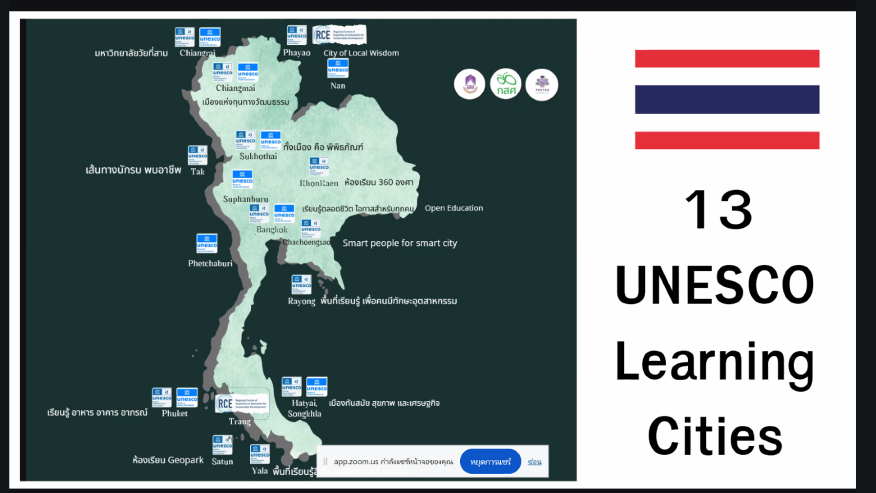
Assoc. Prof. Dr. Phanintra Teeranon first outlined the overall picture of learning cities in Thailand. She noted that Thailand currently has 13 cities in the UNESCO Global Network of Learning Cities (GNLC), distributed across different regions of the country. Their development is driven by diverse actors, including universities, the private sector, and local governments, resulting in distinct models tailored to local contexts.
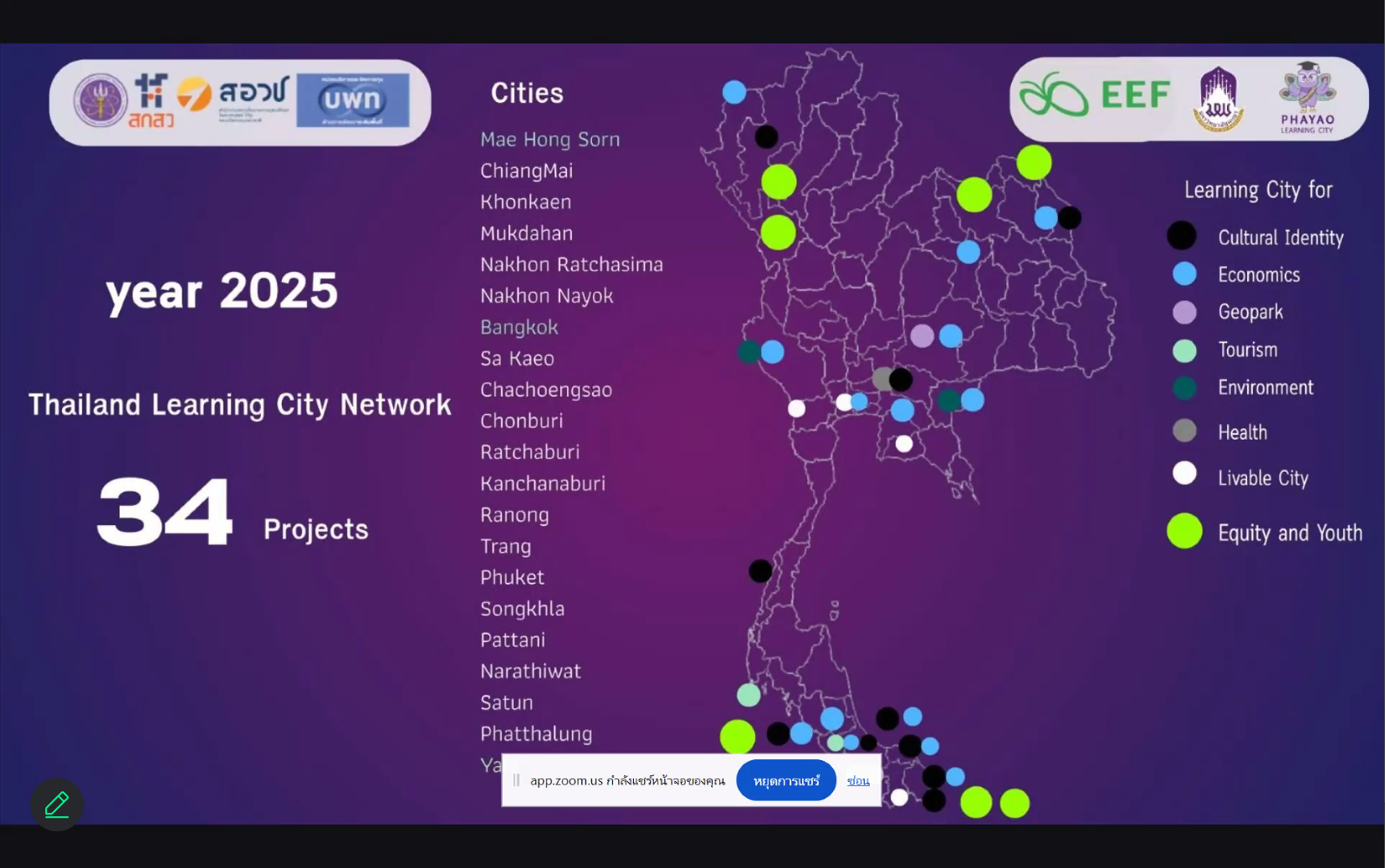
She further explained that Thailand has already developed a domestic learning city network comprising 34 cities. Its origins can be traced back to 2005, when the Office of Knowledge Management and Development (OKMD), under the Office of the Prime Minister, together with the Thailand Knowledge Park (TK Park), began promoting the initiative and established around 27 core lifelong learning spaces across 24 provinces. In 2020, the Equitable Education Fund (EEF), also under the Office of the Prime Minister, became involved and advanced educational equity and learning city development through funding and research. In recent years, the Program Management Unit on Area-Based Development (PMUA) under Thailand’s Ministry of Higher Education, Science, Research and Innovation, in collaboration with the University of Phayao, jointly initiated the Thailand Network of Learning Cities, providing funding and technical support to local governments and universities and helping more cities cultivate lifelong learning ecosystems.
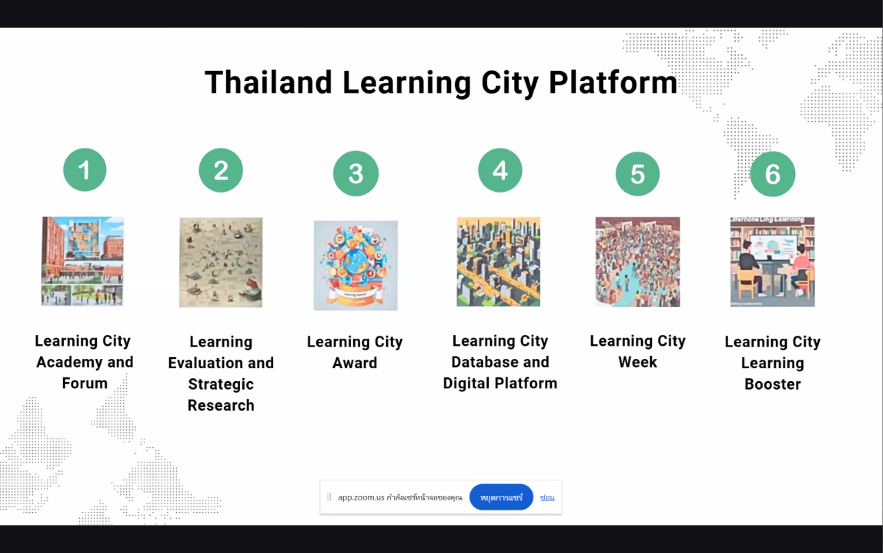
At present, the network has formed a collaborative structure involving several core institutions. OKMD and its TK Park are mainly responsible for learning city festivals and digital platform development. EEF focuses on supporting educational equity projects in border areas and among disadvantaged groups. PMUA mainly funds universities to participate deeply in learning city building through research and practice. As a key coordinating institution, the University of Phayao is responsible for capacity building, award evaluation, international liaison, and on-the-ground guidance for specific cities. Within the framework of the Thailand Network of Learning Cities, these institutions work around six core dimensions: the Learning City Academy and Forum, Learning Evaluation and Strategic Research, the Learning City Award, the Learning City Database and Digital Platform, Learning City Week, and the Learning City Booster Program. Each institution invests in the dimensions most aligned with its expertise, thereby forming a strong collective synergy.
Assoc. Prof. Dr. Phanintra Teeranon also summarized six major lessons from the operation of Thailand’s learning city network. First, each participating organization defines its own goals and key performance indicators (KPIs), while identifying areas of overlap in order to integrate resources. Second, the six dimensions above provide a clear roadmap for action. Third, a support system has been established in which universities and other institutions offer both structured courses and field-based guidance. Fourth, funding and resources from multiple stakeholders—including funding agencies and local governments—are effectively integrated. Fifth, Thailand has made full use of OKMD and TK Park’s experience in organizing learning city festivals to build consensus and popularize the concept. Sixth, a “Learning City Clinic,” coordinated by the University of Phayao, has been created to provide cities seeking UNESCO recognition with end-to-end guidance, from conceptual development to application writing.
During the discussion session, the two sides engaged in in-depth exchanges on specific issues such as collaboration mechanisms among Thai stakeholders and the evaluation framework for learning cities. The seminar provided a valuable window for understanding Thailand’s networked and systematic approach to advancing learning cities. Thailand’s practical experience in cross-sector collaboration, multi-dimensional action, and long-term support mechanisms offers important reference points for China’s efforts to build both a learning city network and a learning society.
China is currently advancing learning city development in a systematic manner. According to available information, in September 2023, China’s Ministry of Education issued a notice calling for the launch of a national learning city network, with member cities of the UNESCO Global Network of Learning Cities serving as demonstration models, provincial capitals playing a leading role, and prefecture-level cities serving as key nodes, while promoting urban-rural integration and gradually expanding coverage. In the first batch, 80 cities, counties, and districts joined the national learning city network. By the end of 2025, the total number of places included in the national learning city network had reached 126.

East side of 7th Floor, No. 3663, North
Zhongshan Road, Shanghai, China, 200062
Tel: +86 21 6223 2322
www.smile.ecnu.edu.cn
版权所有:上海终身教育研究院