
CONTACT US
East side of 7th Floor, No. 3663, North
Zhongshan Road, Shanghai, China, 200062
Tel: +86 21 6223 2322
www.smile.ecnu.edu.cn

Against the backdrop of accelerating climate change and growing concern for educational equity, the systematic examination of rural-urban disparities in climate changeeducation and their environmental justice implications has remained critically underexplored. Understanding the scale of these gaps, the mechanisms that sustain them, and the policy pathways to address them has become an urgent priority for both climate action and educational reform.
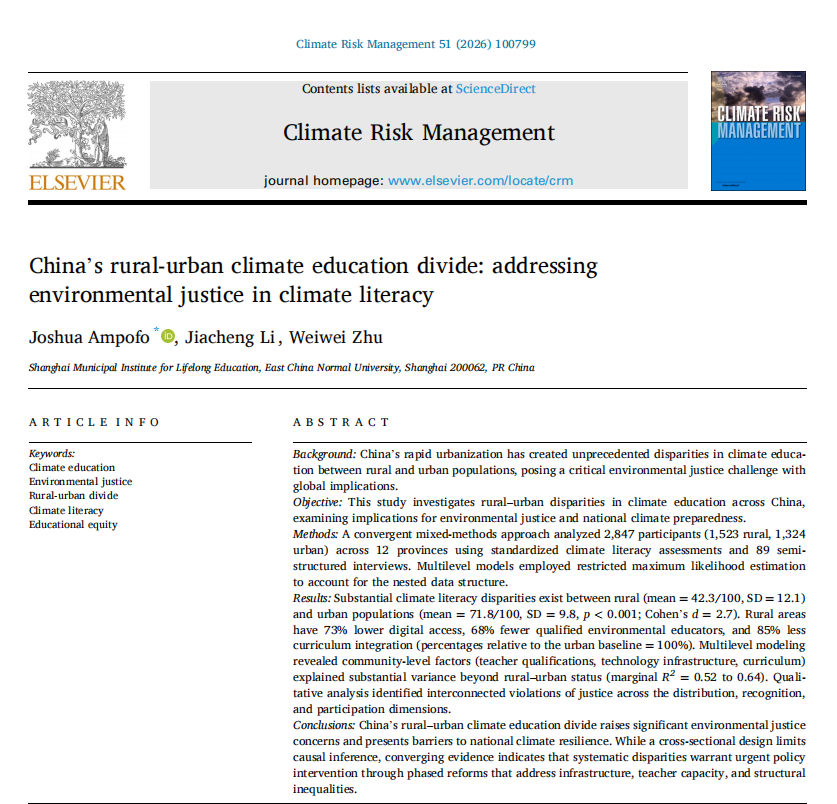
Recently, Joshua Ampofo, Jiacheng Li, and Weiwei Zhu from the Shanghai Municipal Institute for Lifelong Education, East China Normal University, published a research article titled "China's rural-urban climate education divide: addressing environmental justice in climate literacy" in the SSCI-indexed journal Climate Risk Management.

Research Overview
This study examines the significant opportunity to advance climate education equity across China's urban and rural communities, situated within the context of the country's remarkable achievements in urbanization and guided by an environmental justice framework. Through systematic analysis, the study maps the current landscape of climate literacy provision, identifies structural gaps in access and delivery, and articulates a clear pathway toward more inclusive environmental education.
The findings highlight meaningful variation in climate literacy outcomes that point directly to areas of high policy potential: rural residents currently score an average of 42.3 out of 100, compared to 71.8 among urban residents, a 29.5-point difference (Cohen's d = 2.7, p < 0.001) that underscores both the scale of the challenge and the scale of the opportunity for targeted investment. Rural communities stand to benefit substantially from expanded digital infrastructure, greater access to qualified environmental educators, and deeper integration of climate content across school curricula. Each of these dimensions represents not a fixed ceiling but a concrete, measurable target for policy action.
Theoretical Framework and Key Findings
Drawing on Schlosberg's three-dimensional environmental justice framework, the study examines how distributive, recognition, and participatory injustices mutually reinforce one another. A key finding is that rural-urban disparities are not the inevitable result of geographic location, but rather the product of policy decisions, resource allocation patterns, and institutional arrangements. Multilevel modeling revealed that when community-level variables, teacher qualifications, technology infrastructure, and curriculum integration were statistically controlled, the coefficient for rural status decreased by 54%, indicating that targeted institutional interventions could substantially narrow the gap.
Qualitative analysis further uncovered deeper issues of recognition justice: the traditional ecological knowledge, phenological observations, and locally grounded adaptation strategies accumulated by rural communities are rendered largely invisible in urban-centered, standardized curricula. These forms of knowledge are neither incorporated into formal teaching content nor captured by mainstream climate literacy assessment tools, a finding that raises important methodological questions about the epistemological assumptions embedded in climate literacy measurement.
Policy Recommendations and Practical Implications
Based on these findings, the study proposes a phased, feasibility-grounded policy intervention framework. In the short term (1-2 years), priorities include deploying mobile climate education units to rural schools, conducting intensive teacher training programs, and expanding digital infrastructure through government-private sector partnerships. In the medium term (3-5 years), the focus shifts to establishing regional climate education resource centers, implementing rural teacher incentive schemes, and mandating curriculum integration with flexibility for local adaptation. Over the long term (5-10+ years), structural reforms, including the institutionalization of participatory climate education governance, are necessary to address the causes of rural-urban inequality.
The study also highlights that China's rural residents bear disproportionate climate risks while receiving the least support for climate education. Improving rural climate literacy is not only a matter of educational equity but a strategic priority for national climate resilience and global climate action.
Methodological Innovation
Methodologically, the study innovatively integrates a convergent mixed-methods design, three-level hierarchical linear modelling, and qualitative thematic analysis, with systematic triangulation of quantitative and qualitative evidence. This approach enables both precise measurement of the scale of disparities and a rich account of the experiential logic, institutional pathways, and self-reinforcing mechanisms that sustain them, demonstrating the distinctive value of mixed methods for investigating complex social phenomena.
Notably, the study critically examines the epistemological assumptions of standardized climate literacy assessment tools, which privilege Western scientific knowledge frameworks and may inadvertently reproduce recognition injustice by failing to capture the diverse forms of climate understanding in rural communities. This reflection offers important guidance for the development of future climate education research instruments.
About the Research Team
The research team at the Shanghai Municipal Institute for Lifelong Education, East China Normal University, has a sustained focus on the intersections of lifelong learning, climate change education, and educational equity, with a growing portfolio of publications in leading international journals. Looking ahead, the team will continue to advance both theoretical and empirical work in climate education justice, with particular attention to integrating traditional ecological knowledge into assessment frameworks, developing participatory climate literacy tools, and designing longitudinal studies to track the evolution of rural-urban education gaps over time.
Original Article:https://doi.org/10.1016/j.crm.2026.100799

East side of 7th Floor, No. 3663, North
Zhongshan Road, Shanghai, China, 200062
Tel: +86 21 6223 2322
www.smile.ecnu.edu.cn
版权所有:上海终身教育研究院