
CONTACT US
East side of 7th Floor, No. 3663, North
Zhongshan Road, Shanghai, China, 200062
Tel: +86 21 6223 2322
www.smile.ecnu.edu.cn

Against the backdrop of an increasingly severe global climate crisis and persistent reflection on the predicament of anthropocentrism, the field of environmental education urgently needs to move beyond a single Western theoretical framework and construct an educational philosophy grounded in cross-cultural dialogue. Drawing on both Chinese and Western intellectual resources to conduct comparative philosophical research, exploring a relational understanding of the human–nature relationship, and reshaping the underlying philosophy of environmental education have become important directions for responding to the global ecological crisis and developing contextualized educational practice.
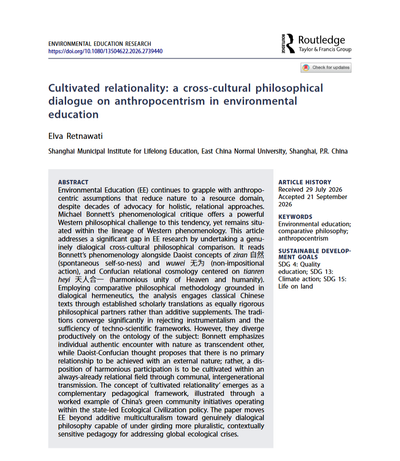
Recently, Dr. Elva Retnawati, a full-time postdoctoral researcher at the Shanghai Municipal Institute for Lifelong Education, published a research article titled "Cultivated relationality: a cross-cultural philosophical dialogue on anthropocentrism in environmental education" in the SSCI-indexed journal Environmental Education Research.

Research Overview
This paper addresses the persistent anthropocentric and instrumentalist tendencies in Environmental Education (EE) by conducting a genuinely dialogical cross-cultural philosophical comparison between Michael Bonnett’s phenomenological critique and classical East Asian cosmologies, specifically Daoist ziran (spontaneous self-so-ness) and wuwei (non-impositional action), alongside the Confucian ideal of tianren heyi (harmonious unity of Heaven and humanity). Moving beyond superficial “additive multiculturalism,” the study employs dialogical hermeneutics to engage with these traditions as equally rigorous philosophical partners, revealing a profound convergence in their shared rejection of techno-scientific instrumentalism, alongside a productive ontological divergence regarding the nature of the subject: whereas Bonnett emphasizes an individual’s authentic, contemplative encounter with nature as a transcendent other, Daoist-Confucian thought posits an “always-already relational” personhood embedded within a non-dualistic cosmos.
Theoretical Framework and Main Findings
The study’s central theoretical contribution is the emergence of “cultivated relationality,” a novel pedagogical framework that redefines environmental education not as isolated individual reflection, but as the formation of harmonious participatory dispositions through sustained, communal, and intergenerational practices. This conceptual breakthrough is practically anchored through a worked example of China’s grassroots green community initiatives, demonstrating how shifting the pedagogical focus toward place-based, multi-generational stewardship offers a robust, pluralistic pathway to transcend anthropocentric limitations and address global ecological crises.
Policy Recommendations and Practical Implications
The study offers transformative policy recommendations and practical implications for EE by advocating a paradigm shift from individualistic, episodic interventions toward community-embedded, intergenerational pedagogies grounded in “cultivated relationality.” Curriculum design should prioritize multi-generational community projects, such as shared urban gardens, local ecosystem restoration, and eco-cultural festivals, over isolated reflective activities, expanding learning outcomes to include relational competencies like empathic expansion and collective stewardship. Rather than relying on extractive, one-off nature experiences, EE programs must foster continuous, participatory engagement with local socio-ecological rhythms, while assessment frameworks should shift from measuring individual knowledge acquisition to evaluating communal capacity, the sustainability of participatory practices, and the qualitative depth of human and more-than-human relationships. Furthermore, the research suggests hybrid pedagogical models in which Bonnett’s phenomenological practices (e.g., sensory attunement and reflective journaling) are integrated into community learning circles structured around relational harmony, allowing Western contexts to strengthen place-based intergenerational networks and East Asian or Global South contexts to affirm and refine existing cultural strengths rather than adopting imposed individualistic models. Ultimately, these insights urge policymakers and educators to move beyond dominant anthropocentric frameworks by embracing philosophical pluralism.
Methodological Innovations
Grounded in dialogical hermeneutics, the methodology innovatively reads these non-Western traditions explicitly as philosophies of education focusing on processes of embodied cultivation, intergenerational transmission, and communal participation rather than reducing them to decontextualized cultural wisdom or spiritual platitudes.
Full Article:https://doi.org/10.1080/13504622.2026.2739440

East side of 7th Floor, No. 3663, North
Zhongshan Road, Shanghai, China, 200062
Tel: +86 21 6223 2322
www.smile.ecnu.edu.cn
版权所有:上海终身教育研究院