
CONTACT US
East side of 7th Floor, No. 3663, North
Zhongshan Road, Shanghai, China, 200062
Tel: +86 21 6223 2322
www.smile.ecnu.edu.cn

The rapid development of artificial intelligence technology is profoundly changing the ways knowledge is produced, disseminated and acquired, while the deepening drive to build a learning society is placing new demands on the supply of lifelong learning resources and on the social service of universities. Against this backdrop, how can universities draw on international experience, stay grounded in Chinese practice, and give full play to their strengths to better serve lifelong learning for all? On October 21, the 14th Shanghai Forum on Lifelong Education opened at East China Normal University. Renowned scholars from the Republic of Korea, Kazakhstan, Austria, the United States and other countries, as well as from international organizations, gathered with Chinese experts to jointly explore how universities can serve the building of a learning society in the intelligent era. Through keynote reports, thematic sessions, roundtable discussions, and other formats, this year’s forum systematically presented cutting-edge ideas, practical experience, and innovative explorations from universities in China and abroad on serving the building of a learning society. The forum attracted more than 200 on-site participants from universities, research institutes, primary and secondary schools, community (senior) education institutions, hospitals, enterprises and other organizations, while its livestream drew more than7,000 online views.
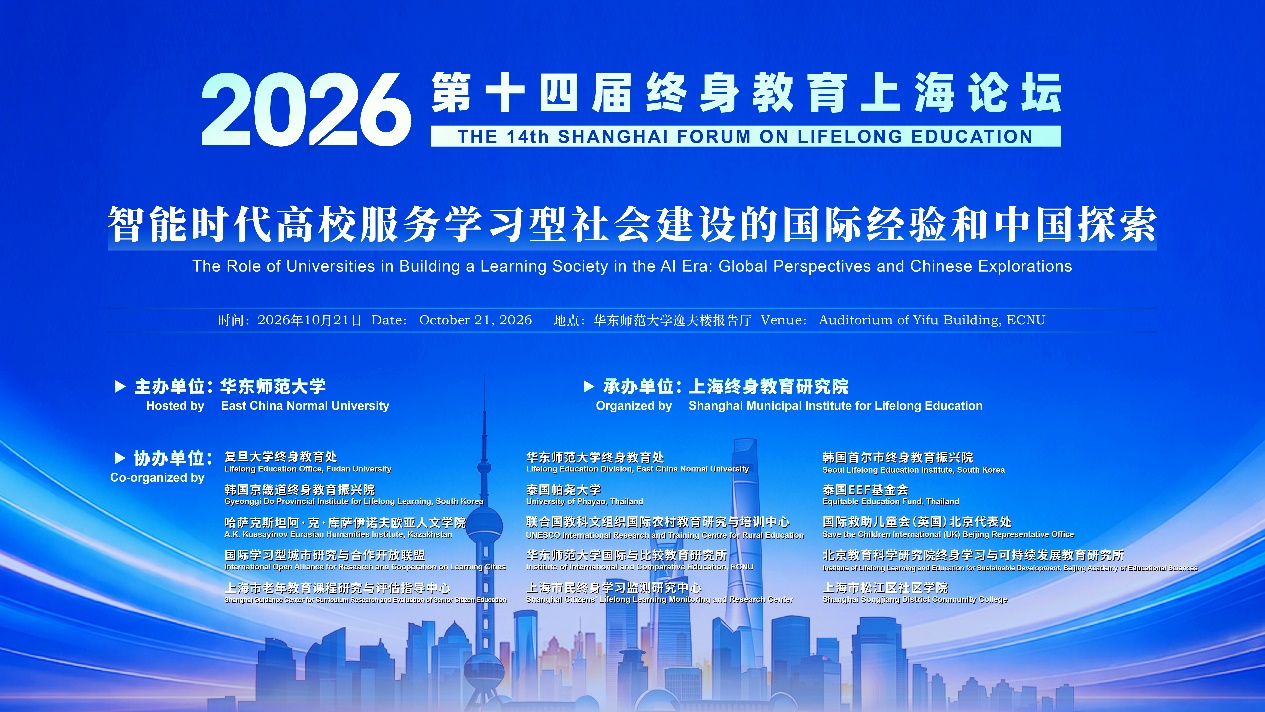
The 14th Shanghai Forum on Lifelong Education opens at East China Normal University
At the opening ceremony, Wang Qinghua,, Member of the Standing Committee of the University Council, East China Normal University, and Ye Linlin, Deputy Director of the Shanghai Municipal Education Commission, delivered speeches in turn. The ceremony was hosted by Li Jiacheng, Executive Vice President of the Shanghai Municipal Institute for Lifelong Education.
In his speech, Wang Qinghua said that the new round of scientific and technological revolution led by artificial intelligence is profoundly changing how knowledge is produced, disseminated, and acquired, and that universities should proactively expand their social service functions, shifting from mainly serving school-age students to serving lifelong learning for all. East China Normal University has always regarded serving lifelong learning for all as an important mission. Relying on the Shanghai Municipal Institute for Lifelong Education, it has long supported the development of community education and senior education nationally and in Shanghai. It has also actively explored building lifelong education as an academic discipline, as well as practical pathways for deeply integrating lifelong education with industrial development, expanding the university’s role from a “provider of education for specific stages of schooling” to a “supporter of learning across the entire life course.”
Wang Qinghua further pointed out that lifelong learning in the intelligent era faces new development opportunities, as well as challenges such as the digital divide and algorithmic irregularities. Universities need to further break down campus boundaries, open up high-quality resources, strengthen coordination and collaboration with all kinds of lifelong education institutions, and build a sound evaluation system, while distilling Chinese experience through international comparison and constructing an independent knowledge system for lifelong education. He expressed the hope that this forum would serve as an opportunity to deepen cooperation among universities, research institutions and international organizations in China and abroad, contributing to accelerating the building of a leading country in education and advancing the building of a learning society.
Ye Linlin, Deputy Director of Shanghai Municipal Education Commission, noted that the intelligent era is expanding the boundaries of university education in terms of time, services and social responsibilities, and universities should proactively serve the building of a learning society. He explained that Shanghai is advancing comprehensive higher education reforms centered on “emphasizing service and strengthening contribution” and “a tailored policy for each institution.” He hoped that more universities would incorporate serving lifelong learning into their overall development planning and strive to become learning organizations that keep learning and continuously innovate. He also expressed support for universities opening up more high-quality resources and promoting the organic connection of diverse forms of education, including degree education, continuing education and community learning.
Ye stated that Shanghai is willing to use platforms such as the Shanghai Forum on Lifelong Education to continuously deepen practical cooperation with international learning cities and universities, conducting joint research on adult learning support, the application of intelligent technologies, the recognition of learning outcomes, and learning city governance. The aim is to better combine international experience with Chinese practice, turn universities’ strengths in knowledge and talent into strengths for serving society and the people, and jointly create a brighter future in which lifelong education is more open, of higher quality and more caring.

At the forum
In the keynote session, experts and scholars from China, the Republic of Korea, Kazakhstan, the United States, Austria and other countries shared insights on the diverse pathways through which universities can serve the building of a learning society in the intelligent era. Topics covered senior education provided by Chinese universities, the building of universities for lifelong education, the transformation of universities’ roles as they proactively embed themselves in the learning society, and flexible learning pathways and credit recognition. They also included international cases such as lifelong education programs at Korean universities, digital and intelligent empowerment of lifelong foreign language learning in Kazakhstan, a critical AI literacy framework for the whole of American society, and Austria’s lifelong education system and distinctive practices. The presentations showcased how different countries and regions draw on university resources to expand lifelong learning services, and explored new directions for lifelong learning and the public responsibility of universities amid the development of intelligent technologies, offering diverse perspectives for learning from international experience and advancing exploration in Chinese practice.

At the forum
The successful holding of this forum is an important step by universities to proactively integrate into the building of a learning society and to explore the innovative development of lifelong education in the intelligent era. Through mutual learning between international experience and Chinese exploration, the forum presented diverse pathways for universities to expand lifelong learning services and promote the open sharing of high-quality educational resources. It deepened understanding of the transformation of universities’ roles and their public responsibility in the intelligent era, and offered valuable ideas for universities to better serve lifelong learning for all and advance the building of a learning society.

Group photo of the 14th Shanghai Forum on Lifelong Education
Contributed by: Shanghai Municipal Institute for Lifelong Education

East side of 7th Floor, No. 3663, North
Zhongshan Road, Shanghai, China, 200062
Tel: +86 21 6223 2322
www.smile.ecnu.edu.cn
版权所有:上海终身教育研究院