
CONTACT US
East side of 7th Floor, No. 3663, North
Zhongshan Road, Shanghai, China, 200062
Tel: +86 21 6223 2322
www.smile.ecnu.edu.cn

The research team at the Shanghai Municipal Institute for Lifelong Education, East China Normal University, has long been committed to the intersection of lifelong learning, community education, comparative and international education, education for sustainable development, and digital transformation in education. While comprehensively deepening cooperation with the UNESCO Institute for Lifelong Learning, educational research institutions in BRICS+ countries and relevant economies under APEC, the team continues to publish influential findings in international journals.
Lifelong learning is increasingly recognized as a cornerstone of sustainable and inclusive development. As societies around the world confront the intertwined challenges of environmental degradation, climate risk, and rapid digital transformation, education is called upon not only to transmit knowledge but also to build the competencies, networks, and capabilities through which individuals and communities can act on that knowledge. How community-based education can turn environmental knowledge into everyday environmental action, how climate adaptation knowledge travels among the cities of the Global South, and how adults can be equipped to participate fully and equitably in an increasingly digital society have therefore become pressing questions for educational research, policy, and practice.
Recently, Joshua Ampofo, a full-time postdoctoral researcher at the Shanghai Municipal Institute for Lifelong Education, and his team published three articles addressing these questions in leading international SSCI journals: Journal of Environmental Psychology; Journal of International Development; and Review of Educational Research, the flagship journal of the American Educational Research Association (AERA). Approaching lifelong learning from the perspectives of community education, comparative and international education, and adult digital literacy, the three studies offer complementary evidence on how education can foster sustainable, resilient, and inclusive societies. A brief introduction to each article is presented below.

Article 1 | Bridging the knowledge–action gap: How community-based education is associated with pro-environmental behavior through green literacy in urban and rural China
Journal: Journal of Environmental Psychology (SSCI Q1), Volume 113, Article 103122; published online on 20 June 2026
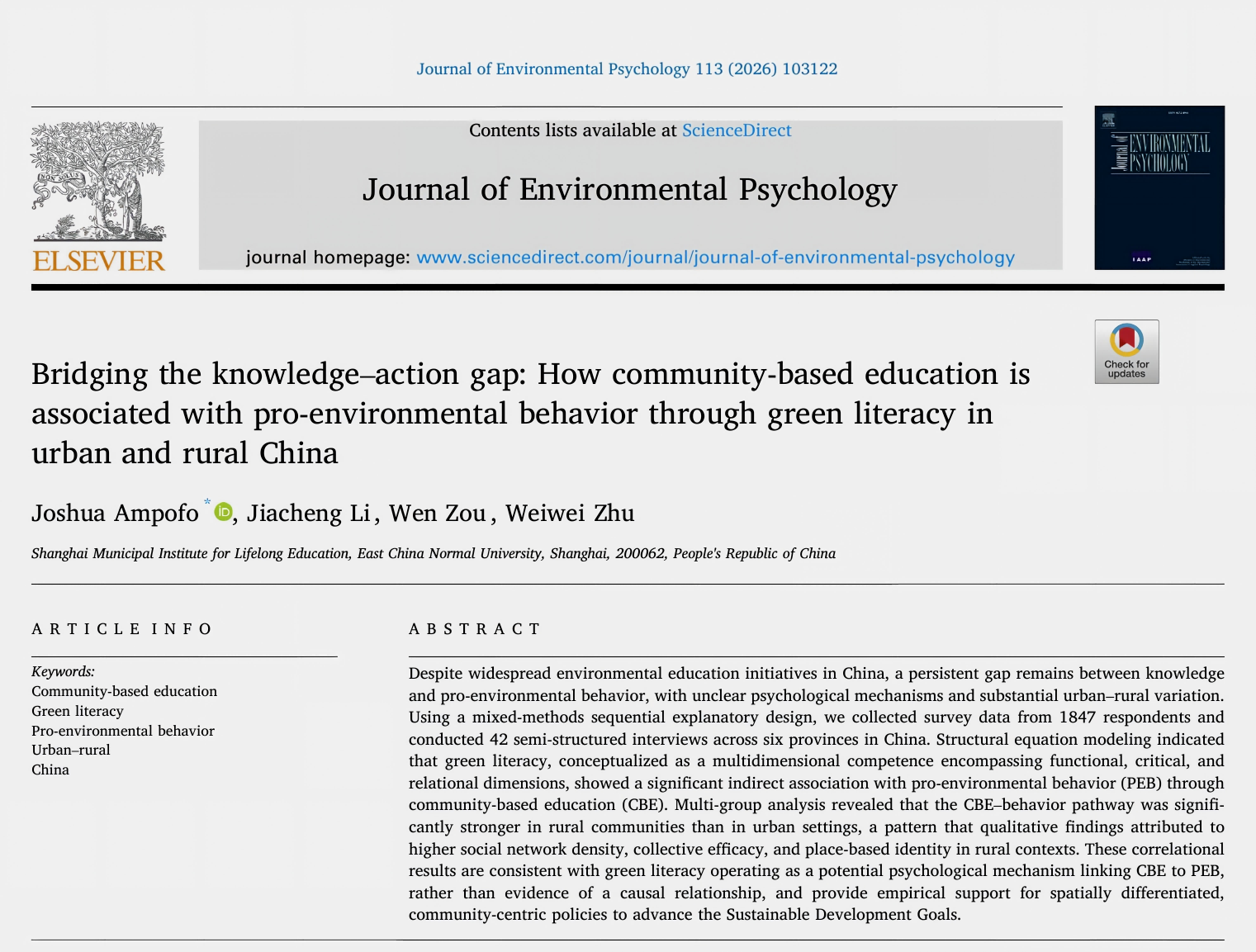
Overview
Addressing the long-standing knowledge–action gap in environmental psychology, this study examines how community-based education is associated with pro-environmental behavior and whether this association operates through green literacy, an integrated competence comprising functional, critical, and relational dimensions. Integrating Social Cognitive Theory and the Value-Belief-Norm framework, the study finds that green literacy accounts for approximately 62% of the total association between community-based education and pro-environmental behavior, with critical literacy, the capacity to evaluate environmental claims, weigh policy trade-offs, and identify root causes, carrying the largest indirect effect. The pathway from community-based education to behavior is more than twice as strong in rural communities as in urban ones (β = .42 versus β = .18), an advantage that the interviews trace to dense social networks, collective efficacy, place-based identity, and intergenerational co-presence. The study therefore calls for tiered, community-centric environmental education policies built on a common national backbone of critical-literacy content.
Full article: https://doi.org/10.1016/j.jenvp.2026.103122
Article 2 | South–South Knowledge Circulation: A Comparative Analysis of Community-Based Climate Adaptation Education in Shanghai, São Paulo and Mumbai
Journal: Journal of International Development (SSCI); published online on 7th July 2026
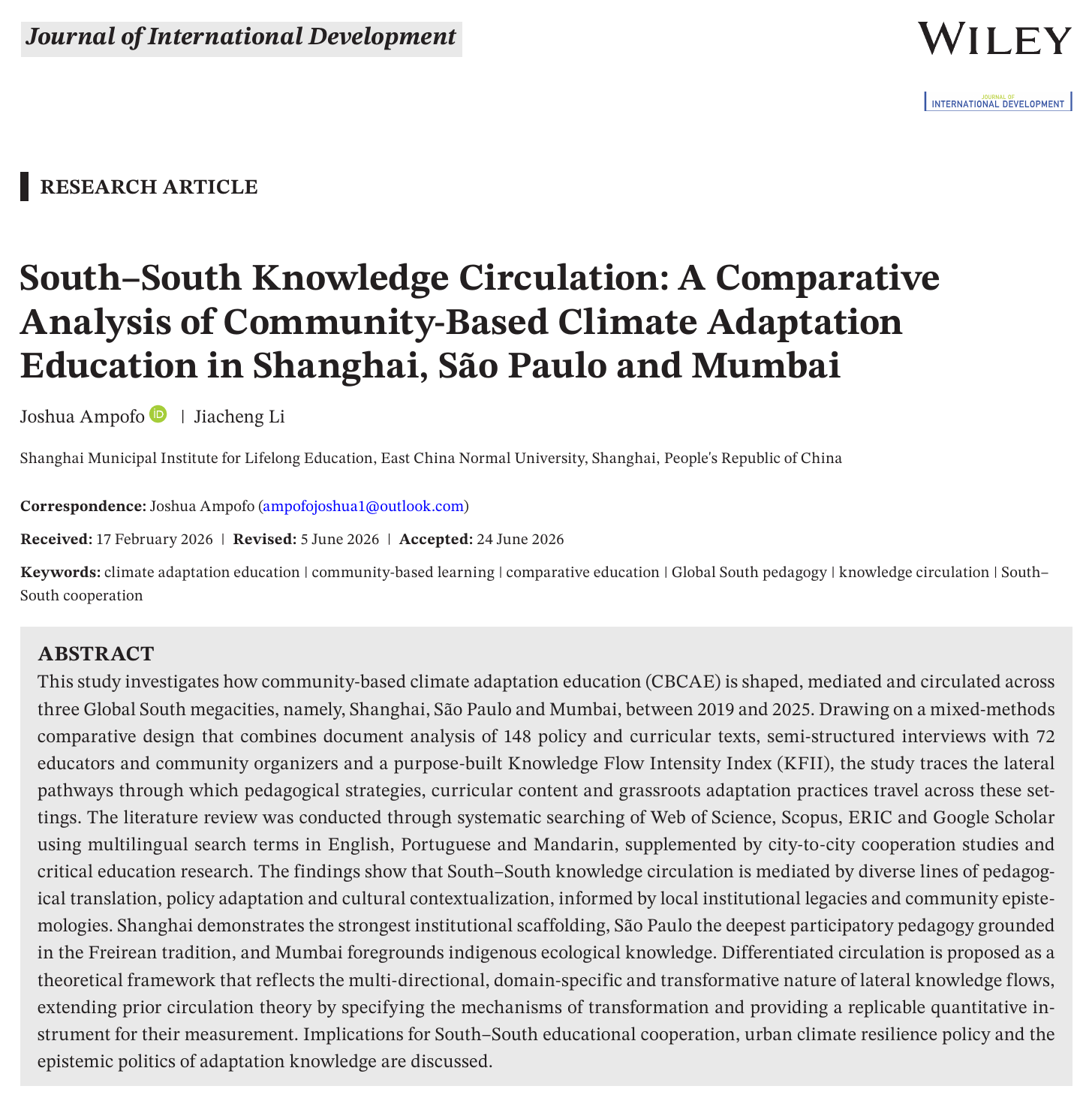
Overview
Moving beyond the conventional focus on North–South educational transfer, this study provides the first systematic comparative mapping of lateral knowledge flows in community-based climate adaptation education among three Global South megacities: Shanghai, São Paulo, and Mumbai. It identifies three channels of circulation, namely formal inter-governmental, professional-organizational, and informal grassroots, and shows that the informal grassroots channel is the most consequential at the community level. Measured with the purpose-built Knowledge Flow Intensity Index, these flows are markedly asymmetric, and each city acts as a sender in some domains and a receiver in others: Shanghai leads in curricular integration and institutional capacity, São Paulo in community engagement and pedagogical innovation, and Mumbai in the incorporation of indigenous ecological knowledge. On this basis, the study proposes "differentiated circulation" as a new theoretical framework and calls on South–South cooperation to invest in the informal architecture of knowledge exchange and to redistribute epistemic authority toward the communities that generate adaptation knowledge.
Full article: https://doi.org/10.1002/jid.70104
Article 3 | Digital Literacy in Adult Lifelong Learning: A Systematic Review of Theoretical Frameworks and Pedagogical Effectiveness
Journal: Review of Educational Research (flagship journal of AERA; SSCI Q1); published online 30th September 2026
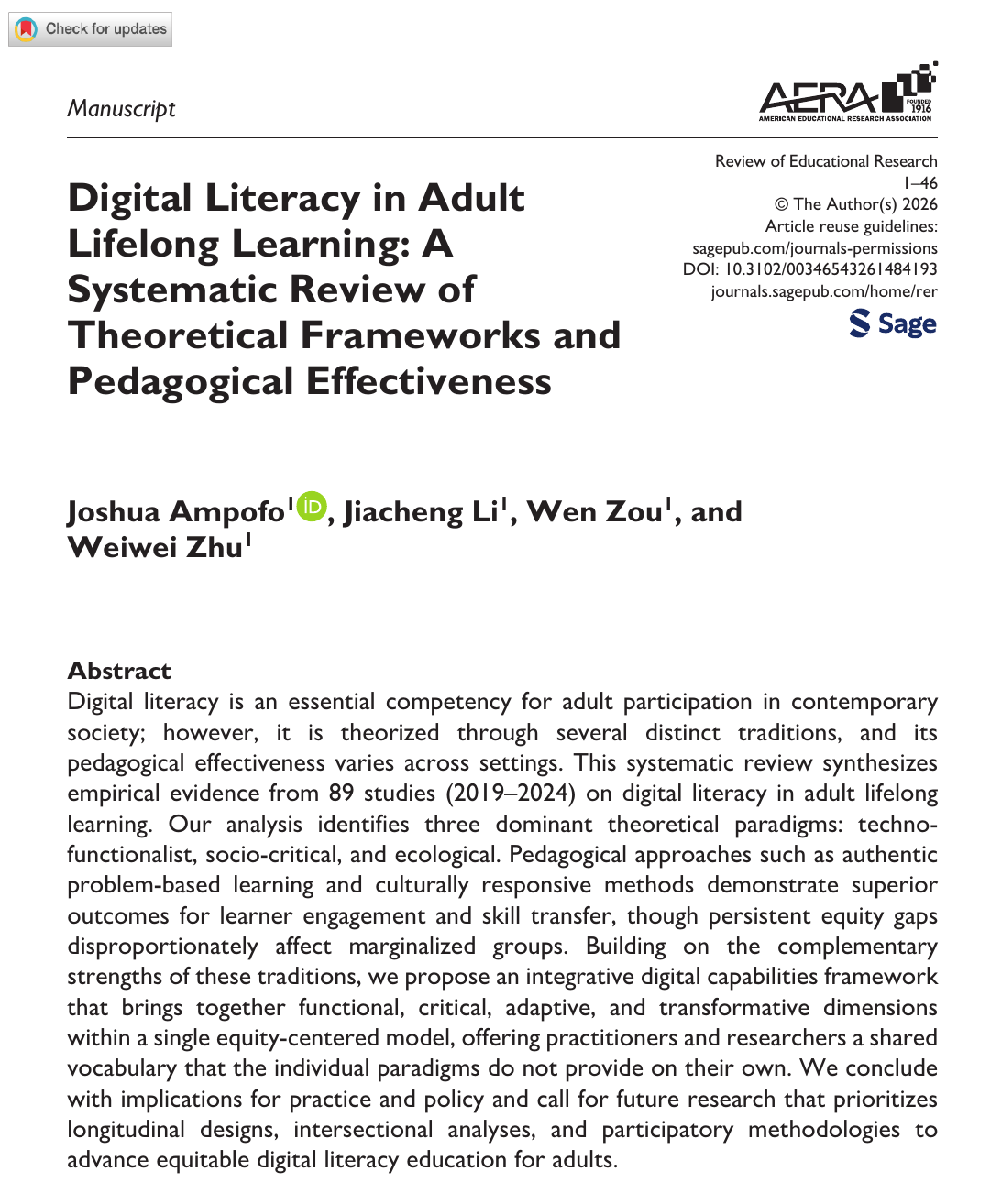
Overview
This PRISMA-guided and PROSPERO-registered systematic review synthesizes 89 empirical studies, screened from 2,847 records, on digital literacy education for adult learners in lifelong learning contexts. It identifies three dominant theoretical paradigms, techno-functionalist, socio-critical, and ecological, and finds that authentic problem-based learning and culturally responsive methods outperform decontextualized skill-building in learner engagement, skill retention, and transfer, particularly when digital literacy is embedded in activities adults already value, such as job search, health management, and civic participation. The review also documents persistent equity gaps: 76% of the studies were conducted in high-income countries, few employed intersectional analyses, and few measured the life outcomes that adult learners themselves most value. To bring the field's complementary traditions into dialogue, the study proposes an integrative, equity-centered digital capabilities framework encompassing functional, critical, adaptive, and transformative dimensions, offering researchers, practitioners, and policymakers a shared vocabulary and a practical roadmap for advancing equitable digital literacy education for adults.
Full article: https://doi.org/10.3102/00346543261484193
Looking ahead, the team will extend these lines of research through longitudinal, experimental, and participatory designs; broader comparative studies across the Global South, including sub-Saharan Africa and Southeast Asia; and research on emerging competencies such as artificial intelligence literacy, with the aim of providing more robust evidence for building an inclusive, sustainable, and digitally empowered lifelong learning system.

East side of 7th Floor, No. 3663, North
Zhongshan Road, Shanghai, China, 200062
Tel: +86 21 6223 2322
www.smile.ecnu.edu.cn
版权所有:上海终身教育研究院