
CONTACT US
East side of 7th Floor, No. 3663, North
Zhongshan Road, Shanghai, China, 200062
Tel: +86 21 6223 2322
www.smile.ecnu.edu.cn

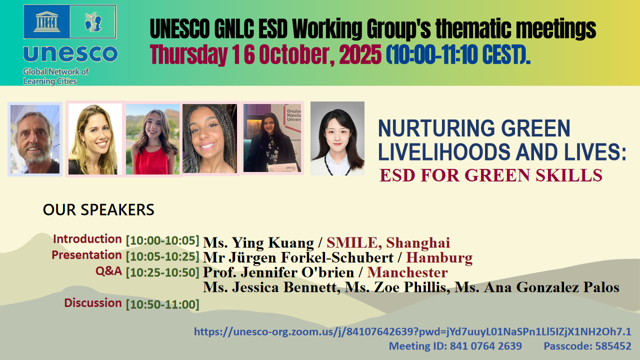
On the afternoon of 16 October, the UNESCO Global Network of Learning Cities (UNESCO GNLC) held an online Working Group thematic meeting on Education for Sustainable Development (ESD). Shanghai Municipal Institute for Lifelong Education participated in organising this meeting, which was chaired by Kuang Ying, a member of the Institute's ESD project team and part-time researcher at the Shanghai Research and Evaluation Guidance Centre for Elderly Education.
Centred on the theme 'Nurturing Green Livelihoods and Lives: ESD for Green Skills', experts and student representatives from UNESCO Learning Cities in Hamburg, Germany, and Manchester, UK, delivered keynote presentations. They shared practical experiences in cultivating green skills, offering diverse perspectives for global ESD development. The meeting was attended by programme officers from the UNESCO Institute for Lifelong Learning and representatives from multiple international Learning Cities.
Hamburg: Driving Green Transformation Through a Systematic ESD Strategy
Mr Jürgen Forkel-Schubert from Hamburg's Ministry for Environment, Climate, Energy and Agriculture served as the inaugural speaker, outlining Hamburg's systematic practices in green skills and ESD. Beginning with the city's fundamental characteristics, he introduced Hamburg's core positioning as a ‘green and blue city’, alongside key urban data including its 1.9 million permanent residents (37% of whom have an immigrant background) and status as Europe's third-largest port. He further outlined the inclusive requirements for Hamburg's ESD practices, grounded in the city's fundamental development imperatives.
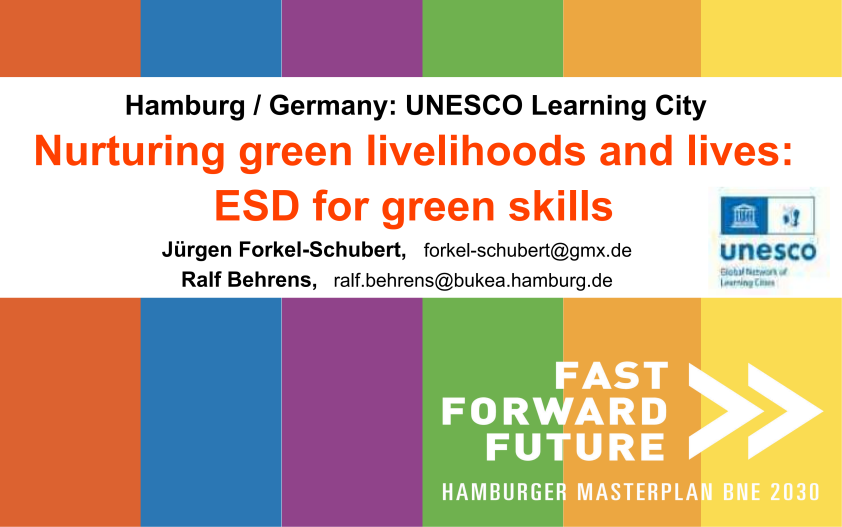
In terms of climate action, Hamburg has established a clear policy framework: the Climate Act was passed in 2020 and enshrined in the constitution, setting targets for a complete phase-out of coal energy and a 70% reduction in carbon emissions by 2030. Landmark projects launched in 2025 include ‘free public transport for all 210,000 schoolchildren in the city’ and ‘transitioning coal-fired power plants to green hydrogen production’. The goal of achieving climate neutrality by 2045 remains firmly in place. To ensure these objectives are realised, Hamburg has established a multi-tiered ESD system: the Hamburg Sustainable Learning Network was founded in 2005, and the ESD Master Plan formally implemented in 2021. With an annual investment of approximately €1 million, the plan advances 100 specific measures across early childhood education, schools, higher education, and non-formal learning sectors.
Manchester: Centred on Higher Education Institutions, Connecting Young People with Green Employment
Professor Jennifer O'Brien, Academic Lead for Sustainability Teaching and Learning at the University of Manchester, alongside three student representatives—Zoe Phillis, an undergraduate in Geography at the University of Manchester; Ana Gonzalez Palos, a Master of Science in Management student; and Jessica Bennett, an undergraduate in Animal Behaviour and Welfare at Manchester Metropolitan University—jointly presented the findings of Manchester's Green Care Mission.
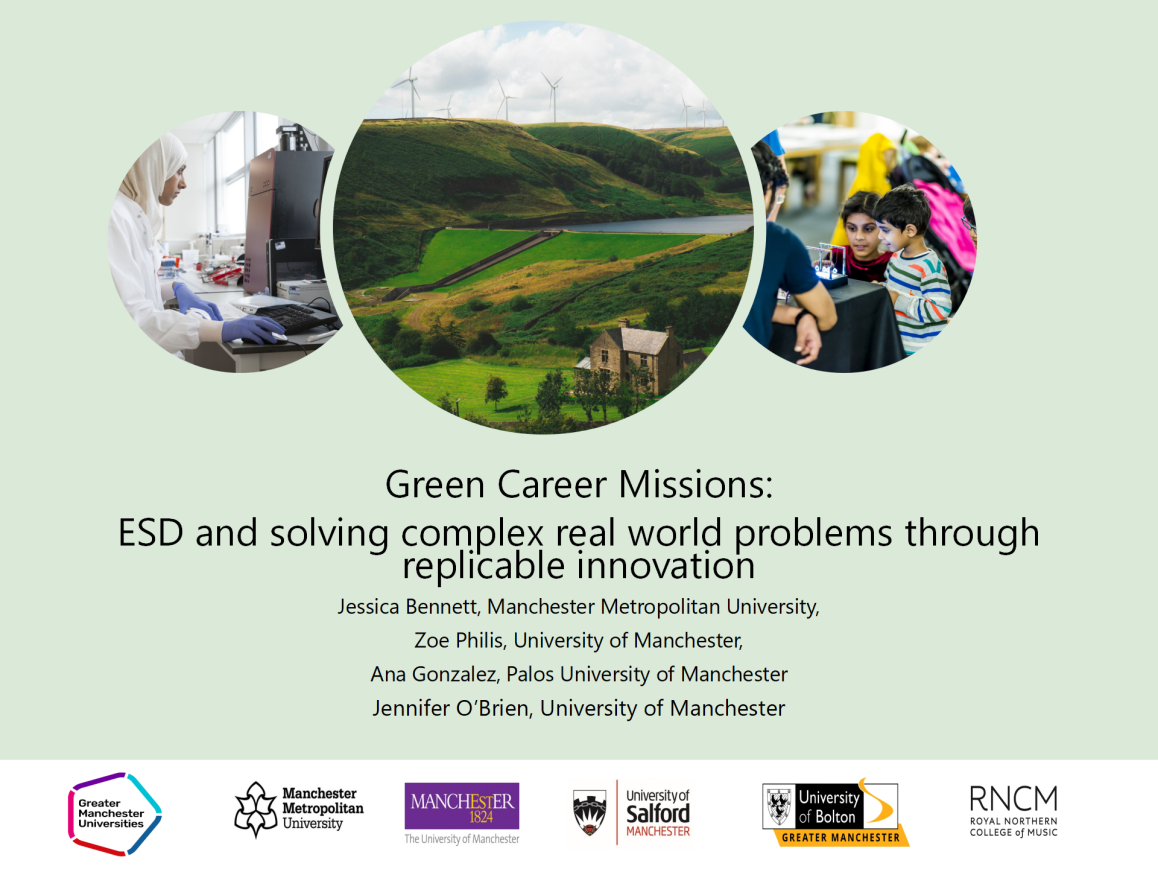
Professor O'Brien first outlined Manchester's climate objectives: the City Council has pledged to achieve carbon neutrality by 2038 and established a "carbon budget" limiting total emissions between 2018 and 2100 to no more than 15.2 million tonnes. To achieve this, the Greater Manchester Universities plays a pivotal role. Through the Civic University Agreement, it closely integrates ESD with green employment, championing the principle that 'all professions can become green professions' to challenge the misconception that green skills are confined to specific sectors.
The student team shared pathways for youth engagement in the green transition from a practical perspective. Three students discussed bridging green skills practice with employment prospects. They presented a prototype carbon footprint tracking app featuring emissions calculation, waste sorting reminders, and self-learning modules—with digital badges enhancing employability. Through experiential ESD, they developed multifaceted competencies while implementing air quality improvement initiatives. Additionally, they highlighted how universities align curricula with employer demands and offer green internships, enabling future graduates to translate ESD knowledge into professional competitiveness.
Dialogue and Prospects: Collaborative Translation Among Global Learning Cities
Participants engaged in in-depth discussions on topics including the complementary nature of Hamburg's systematic policy approach and Manchester's university-driven model, inclusive ESD practices for migrant communities, and mechanisms linking youth green skills with the employment market, alongside specific implementation methods. Mr. Forkel-Schubert and Professor O'Brien emphasised that while the two cities pursued distinct pathways, their core objectives remained aligned: fostering universal green literacy through ESD, catalysing the transition 'from awareness to action', and providing 'accessible, actionable' green engagement scenarios.

Mr Forkel-Schubert spoke highly of the recent academic visit to Hamburg by Shanghai Municipal Institute for Lifelong Education, noting that this interaction had strengthened synergistic cooperation between global learning cities and enhanced mutual learning between East and West. Members of the ESD project team from Shanghai Municipal Institute for Lifelong Education who participated in this conference also stated that they would continue to monitor the practical progress in both cities, promote the integration of international experience with local practices, and provide valuable insights for the development of ESD and the cultivation of green skills in Shanghai and across the nation.

East side of 7th Floor, No. 3663, North
Zhongshan Road, Shanghai, China, 200062
Tel: +86 21 6223 2322
www.smile.ecnu.edu.cn
版权所有:上海终身教育研究院